Scratch-made pizza was a “road to Damascus” home-cooking moment. My oven-baked pizzas were really good. Yet whilst being tasty, and much better than pre-packaged products, they lacked that authentic pizzeria quality.
To go further in my pizza-making journey, I decided that I needed a proper pizza oven. My wife agreed. Seriously, she did … and she also discovered the Big Green Egg.
Welcome! Thanks for stopping by! Down below you’ll find out how I cook pizza in a Big Green Egg, it works for other ceramic cookers. There’s plenty more great info, feel free to browse around whilst you’re here. The most popular technique and pizza posts are:
Pizza On The Big Green Egg Made Easy!
If you’d like to stay up to date with new blog posts, just click the Follow button on the right (or down the bottom for mobile device users). Now, on with cooking pizza in the Big Green Egg …
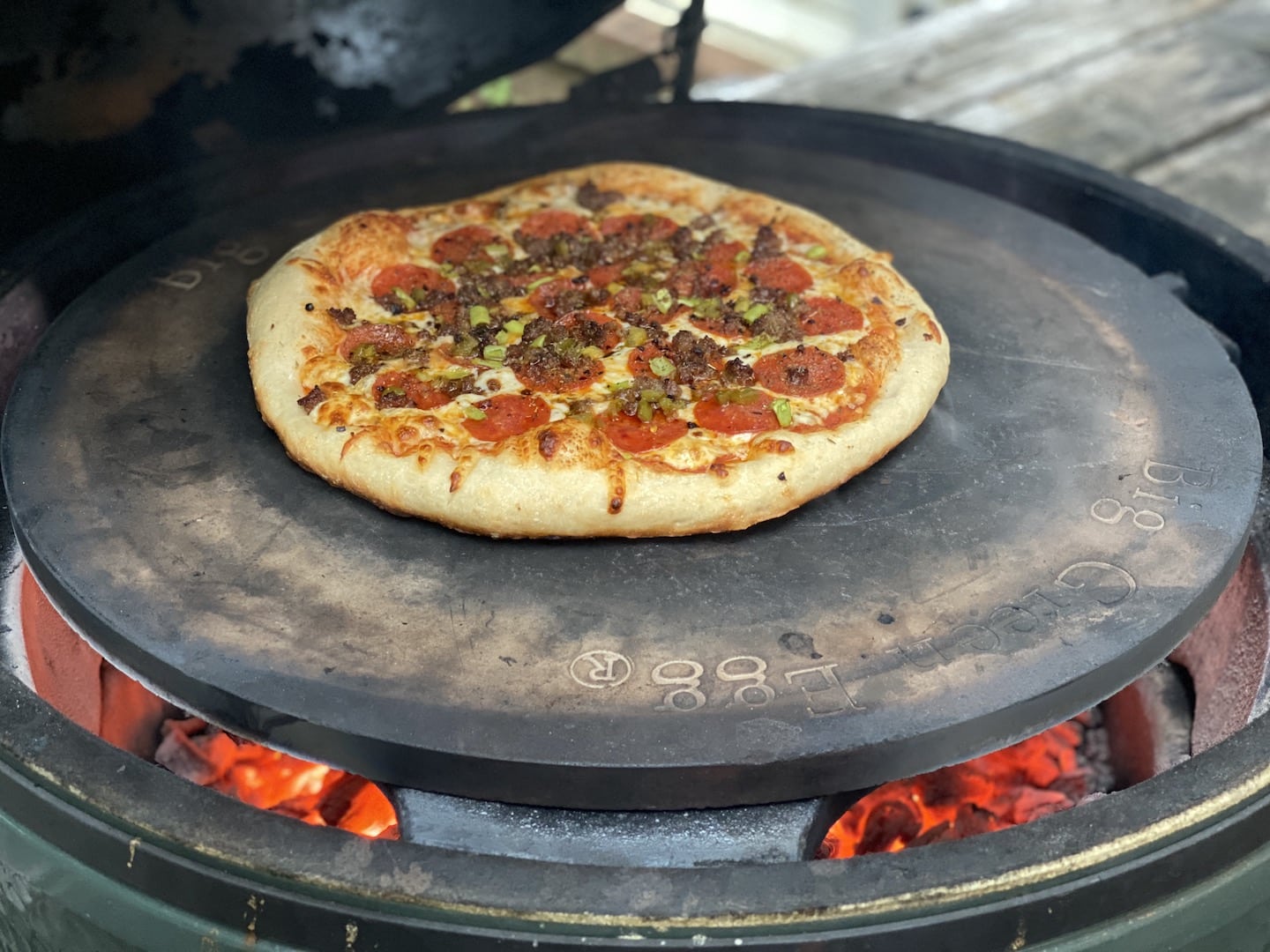
My set-up for pizza is platesetter legs up, standard grid and two fire bricks (not house bricks, they will shatter and damage the BGE). The fire bricks are placed on top of the grid vertically. This raises the pizza stone up into the dome so that heat radiating down from the ceramic lid cooks the toppings at the same rate as the base.
A thick crust pizza can also be cooked using the vertical brick set-up, it depends on the thickness and toppings. If unsure, cook with the bricks flat and see how it turns out, then adapt as necessary. Deep pan pizzas do not need fire bricks, and the pan can be placed directly on the grid.
Pizza On The Big Green Egg Recipe By Michal Misho Papuga
Using fire bricks for thin crust pizza made a big difference to both quality and consistency. In addition, the pizzas had that lovely slightly burnt edge pizzeria look. The fire bricks that I use are 114mm high. The platesetter needs to be sitting on the BGE fire ring, any higher and the thermometer may touch the pizza.
Get this set up when the coals have lit, so that as the Egg comes up to temperature the stone warms as well. Continue to warm the stone for 20-30 minutes after the Egg has got to the desired temperature (see next section) before baking the pizza. I check that the pizza stone is ready by using a handheld instant read temperature gun.
Whilst 400°C may seem excessive, consider that an authentic Neapolitan pizza is cooked at 485°C for 60-90 seconds. The above temperatures are guides, and are partly dependent on the dough being used. After a few cooks you’ll find your sweet spot.
Big Green Egg Pizza
To get the Egg to a high temperature, ensure that the firebox is full of charcoal and possibly even going into the fire ring. This will mean more pieces generating heat, but also less air space to heat up. Doing this will cause the Egg to get to a higher temperature, and relatively quickly. In addition, remove the daisy wheel completely and control the temperature with the bottom grate.
For your first time cooking pizza on a Egg, I recommend going with thin crust and cooking at 300°C/570°F for 7-9 minutes (or thick crust at 260°C/500°F for 8-10 minutes). It’s easy to cook an underdone pizza for a few more minutes, but impossible to go back in time and fix a burnt pizza cooked at too high a temperature. Once you get the hang of it, experiment with crust, toppings, temperature and time.
For cooking up to 300°C/570°F, you can use baking parchment to transfer the pizza to the stone. Higher temperatures require a tool such as a pizza peel, preferably a wooden one. I use a Superpeel to deploy the pizza into the Egg.
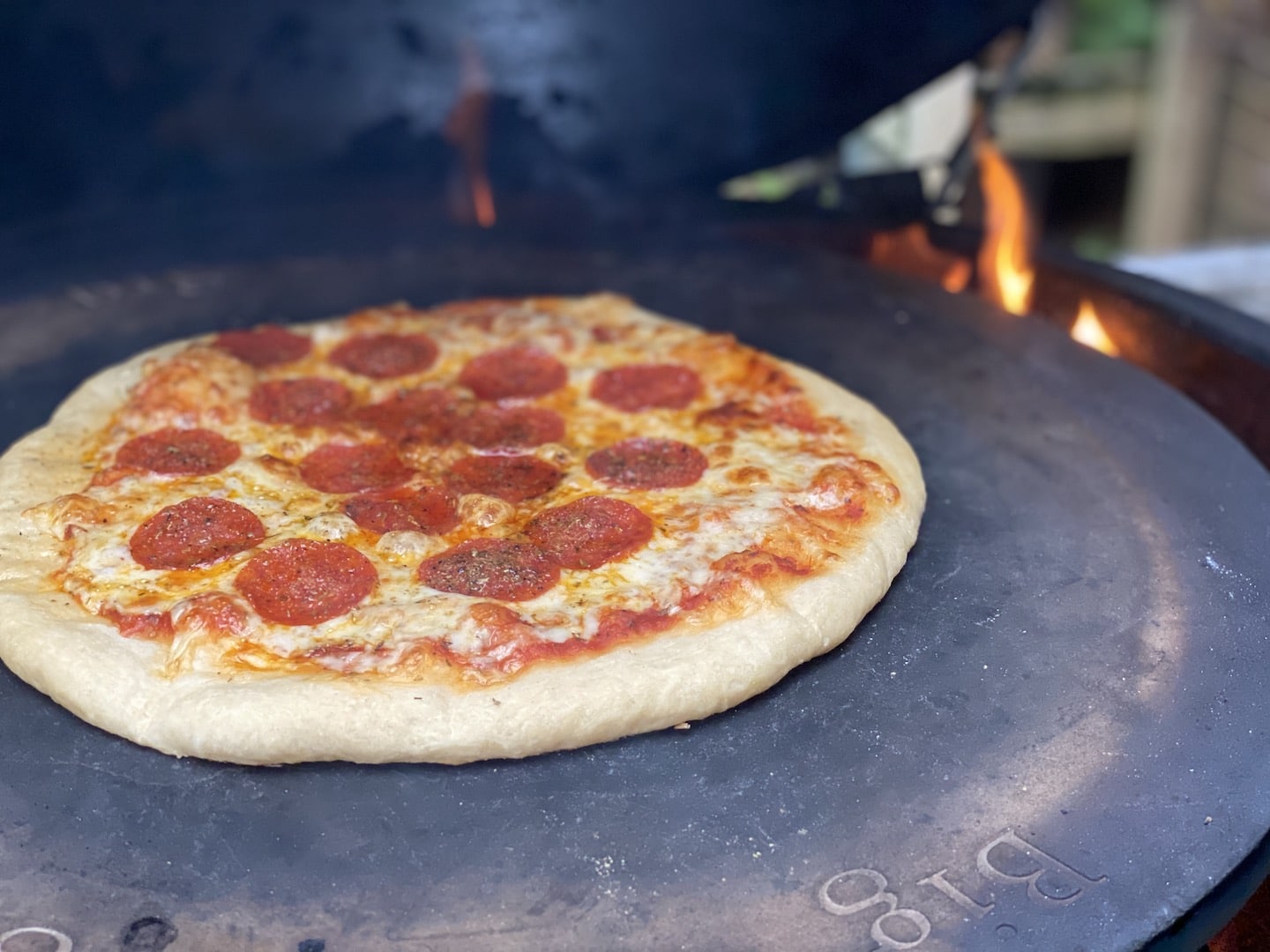
Pizza On Green Big Egg
The pizza will probably need to be rotated during cooking to ensure an even cook, for this I use a steel pizza peel.
The picture below shows cornmeal on the pizza stone. Burnt cornmeal. I used to think that using cornmeal was essential to safely getting the pizza off the stone. However, this isn’t the case. Pizza dough won’t stick to a hot (i.e. pre-heated) pizza stone. So I just ended up with burnt cornmeal and a slightly burnt base. I don’t use cornmeal for dusting the stone anymore.
Does it make that much difference? Yes, absolutely. In my experience there’s no contest, pizzas cooked in a BGE win every time. For the Ham and Mushroom pizza article, I used our oven. My wife said “It’s good, and it also shows how much better pizza tastes when cooked in our egg”.Thanks to the Big Green Egg, you don’t need a wood-fired brick oven to get the best pizza – backyard grillers as well as renowned chefs around the world know that, when set for indirect cooking, the EGG performs like a super-efficient fire brick oven. In fact, EGG owners know a secret … that the Big Green Egg bakes better than wood-fired ovens ever could, because heat from the natural charcoal radiates in a convective flow within the thick ceramic walls of the dome, allowing your pizza to cook very evenly.
Big Green Egg Aluminium Pizza Peel
Our complete line of flat and deep-dish baking stones makes it easy to perfectly bake a variety of recipes, from pizza, artisan breads, casseroles, quiche and lasagna to pastries, pies and desserts. Our baking stones are made to the same specifications as the EGG itself, so they distribute heat evenly for better baking and browning, and the ceramics pull moisture from the outer surface of the pizza dough for delicious brick oven crispiness. And, because the stones retain heat so efficiently, your food conveniently remains warm longer.
Pizza works best using the indirect cooking method, which means adding a barrier between the direct heat and the food, turning your EGG into a convection oven. To set the EGG for indirect grilling, add natural lump charcoal to the top of the fire box and light. Open the top and bottom vents and let the EGG rise to the desired temperature. Place the convEGGtor in the EGG with the legs up and place the cooking grid on top (if you have the EGGspander, you can use a baking stone in the bottom piece – the convEGGtor Basket – to create the same effect). Add a pizza stone to the cooking grid, and allow it to come up to temperature with the EGG. Adjust the top and bottom vents to maintain the desired temperature.

Dough: Whether you use store-bought, homemade or frozen dough, it will always taste better on the Big Green Egg! If you are using a ball of dough that needs to be stretched, take the dough out of the refrigerator 3 hours before you plan to start cooking to make it easier to work with. The cooking temperature of the EGG depends on what kind of dough you are using. For doughs that contain sugar, a lower cooking temperature should be used to avoid burning; doughs made with little or no sugar allow for higher temperatures. We always recommend following the product’s cooking instructions when using store-bought dough.
Cast Iron Deep Dish Pizza
Sauce: There are many different sauces that can be used on top of the dough, such as pesto, red, white … or just olive oil and herb. Using too much sauce on your pizza will lead to a soggy crust; a light coat is all you need! Place the sauce in the middle and spread outward; be sure to leave about ½ inch for the crust.
Vegetables: Get creative with any vegetable that you like! A great tip is to dab the vegetables with a paper towel to draw out any moisture before adding them to the pizza. Another option is to cook the vegetables before putting them on the pizza. There is no wrong answer here; figuring out your preference is half the fun of it!
Herbs: DO NOT SKIP THIS STEP! You will thank us later! Fresh basil, oregano and thyme are some of the favorite herbs for pizza.
A Pizzaiola's Guide To Pizza On The Big Green Egg
Meat: Never use raw meat on the pizza. If sausage or ground beef is used, be sure to cook it before it goes on the pizza.

Cheese: Shredded or sliced mozzarella is the favorite cheese for pizzas, but let’s be honest … any cheese is delicious! A few popular options are Romano, Asiago, Parmesan, Dry Jack, Provolone or Gruyere. Have some fun pairing different cheeses with different ingredients … Buffalo chicken blue cheese pizza, anyone?
When making a pizza for the Big Green Egg the key is to have fun with your ingredients and use the ones that make you happy!
Pizza Recipe At Big Green Egg
Spreading semolina flour (doesn’t char as easily as other flours) or cornmeal (can leave a gritty texture on the dough if you use too much) on the pizza peel and pizza stone makes it easy to get the pizza on and off the stone without sticking. Remember to put down more flour or cornmeal as needed if you are making more than one pizza.
Using parchment paper under the pizza also prevents the dough from sticking. Use a piece of parchment paper under the dough when making the pizza and, when it’s ready to cook, place the parchment paper with the pizza directly on
0 Response to "Big Green Egg Pizza Recipe"
Posting Komentar